
Reference: Section 120.1(d)5, Section 120.2(e)3
The use of occupied-standby zone controls is mandated for spaces that are also required to use occupant sensing controls to meet the requirements for lighting shut-off controls per Section 130.1(c). Example spaces include offices, multipurpose rooms 1,000 sq. ft. or less, classrooms, conference rooms, and other spaces where the space ventilation is allowed to be reduced to zero in Table 120.1-A (see note F in the right-hand column of the table).
The HVAC system shall be controlled by an occupancy sensing control that resets temperature setpoints and ventilation air in accordance with Section 120.1(d)5 and Section 120.2(e)3 when a space meets both the following conditions.
- Section 130.1(c)5 and 6 specify that occupant sensing, as opposed to time-switch, is required to implement shutoff controls.
- Table 120.1-A specifies that ventilation air in the space is allowed to be reduced to zero when the space is in occupied standby mode.
- The zone and ventilation system is not served by pneumatic controls.
Table 4- 1: Occupancy Categories Qualifying for Occupied Standby Control Requirements lists all the occupancy categories that meet both conditions above and thus are required to install occupied standby controls if the ventilation zone is serving only qualifying spaces. Note that the “Corridors” category is duplicated from the general category and offices are duplicated from the office category to other building types for clarity.
| Occupancy Category |
|---|
| Offices |
| Multiuse assembly less than 1,000 sqft |
| Classrooms |
| Corridors |
| Conference Rooms |
| Restrooms |
| General |
| Guest rooms in hotel/motel |
Source: California Energy Commission
Occupied-standby zone controls are used to implement “occupied standby control.” This control is used when the HVAC is scheduled to be ON, but occupancy sensors do not detect any activity in the spaces served by the HVAC zone. During occupied standby, zone temperatures are reset (higher cooling setpoint and lower heating setpoint) and during times when there is neither a call for cooling nor heating the ventilation air is shut off to the zone. When ventilation air is shut off to the zone, the ventilation system serving the zone shall reduce the system outside air by the same amount of outside air reduced at the individual zone. For systems using DOAS units, please see the special note at the end of this section.
Where occupied-standby zone controls are employed (whether mandated or not) the controls must meet all of the following requirements:
- Sensors must meet the requirements of Section 110.9(b)4 and shall have suitable coverage to detect occupants in the entire space.
- Sensors that are used for lighting can be used for ventilation if the ventilation system is controlled directly from the occupant sensor and is not subject to daylighting control or other manual overrides.
- If a space conditioning system(s) serves several enclosed spaces, each space shall have its own occupant sensor and all sensors must indicate lack of occupancy before the zone airflow is cut off.
- The occupant sensor override of ventilation shall be disabled during preoccupancy purge (i.e., the terminal unit and central ventilation shall be active regardless of occupant status). Preoccupancy purge occurs during times that are scheduled to be unoccupied and the HVAC system is scheduled off and thus does not overlap with occupied standby periods.
- Single zone systems when “floating” between a call for heating or cooling will be shut off. For multizone systems, when a zone enters occupied standby and sets its zone airflow to zero, the system outside airflow shall be reduced to account for the reduced need for outside air. ASHRAE Guideline 36-2021, High-Performance Sequences of Operation for HVAC Systems, provides operating sequences that include the specific instructions for resetting air handler outside air amounts in response to a zone being placed in occupied standby while complying with the Title 24, Part 6 minimum outside air flowrates for the other zones.
The following three requirements allow a time delay up to 25 minutes (20 minutes sensor time delay + 5 minute occupied standby time delay) after no occupant activity is detected in all lighting zones served by the space conditioning zone and before the ventilation to the rooms is shut off.
The HVAC system must have the ability to modulate ventilation to each space conditioning zone that must comply with occupied standby mode.
The space conditioning zones and the lighting zones are not required to match controls operation. The illustration below (Figure 4- 8: Control Sequence Diagram of Occupied Standby Control of HVAC Thermal Zone Serving Two Lighting Zones (LZ1 and LZ2) Pre-Occupancy Purge Flowchart) provides an example of the sequence of events for two lighting zones (LZ1 and LZ2) served by one HVAC zone and how occupant-sensing lighting controls relate to the HVAC ventilation controls. If an HVAC zone serves multiple lighting zones, then all lighting zones must be vacant for the HVAC zone to go into occupied standby. If a large lighting zone serves several small HVAC zones within the lighting zone, then all HVAC zones will go into occupied standby when the lighting zone is unoccupied.
- Occupant sensing controls shall indicate that a space or lighting zone is vacant in 20 minutes or less after no occupant activity is detected by any occupant sensors covering the space.
- When all the lighting zones served by the same space conditioning zone are vacant as indicated by the occupant sensing controls, the space conditioning zone enters occupied-standby mode.
- Once a space conditioning zone enters occupied-standby mode, in 5 minutes or less, thermostatic setpoints are reset and mechanical ventilation to the zone shall be shut off until any room served by the space conditioning zone becomes occupied or until ventilation is needed to provide space heating or conditioning. Temperature setback can be achieved either by:
- Automatically set up the operating cooling temperature setpoint by 2°F or more and set back the operating heating temperature setpoint by 2°F or more; or
- For multiple zone systems with Direct Digital Controls (DDC) to the zone level, set up the operating cooling temperature setpoint by 0.5°F or more and set back the operating heating temperature setpoint by 0.5°F or more.
What is ASHRAE Guideline 36?
ASHRAE Guideline 36, High-Performance Sequences of Operation for HVAC Systems, provides peer-reviewed sequences of operation for HVAC systems, written in a format that can be readily implemented by building controls manufacturers and control system contractors. It is continuously updated by a large committee of engineers, manufacturers, scientists, and contractors following the rigorous ASHRAE public review process. These sequences are intended to maximize energy efficiency while maintaining good indoor air quality and comfort. The sequences have been configured and tested to provide control stability and real-time fault detection and diagnostics. Specifying Guideline 36 control sequences reduces risk of Energy Management Control System programming errors and provides a common set of terms and sequences to facilitate communication between specifiers, contractors, and operators.
Example 4-7
Question:
If an HVAC zone is designed to serve an office space, conference room, and corridor, does this configuration require occupied standby capabilities to shut off ventilation?
Answer:
Yes.
Offices Spaces and Corridors all require occupancy sensing controls under Section 130.1(c) AND are occupancy categories that can have their ventilation air reduced to zero when the space is in occupied-standby mode.
- Small offices (250 square feet or less) require occupant sensing controls under 130.1(c)5.
- Large offices (250 square feet or greater) require occupant sensing controls under 130.1(c)6.
- Conference rooms of any size require occupant sensing controls under 130.1(c)5.
- Office Corridors require occupant sensing controls under sections 130.1(c)6.
Corridors which provide that ventilation are subject to occupied-standby mode under Table 120.1-A, as are office spaces (as indicated by the note “F” Column).
Example 4-8
Question:
If an HVAC zone is designed to serve both an office space and classrooms does this configuration require occupied standby capabilities to shut off ventilation?
Answer:
No, for Pre-K and K-12 classrooms.
Yes, for most Higher Education and commercial training classrooms.
As noted in the previous example, the occupied standby mode requirements are triggered if the space is subject to have occupant sensing controls under 130.1(c) AND are occupancy categories that can have their ventilation air reduced to zero when the space is in occupied-standby mode under Table 120.1-A. While all classrooms are required occupant sensing controls under Section 130.1(c)5, only certain types of classrooms can reduce ventilation flow to zero when the space is in occupied-standby mode.
In the case of classrooms, pre-K and K-12 educational facilities and some specialized classrooms such as art classrooms do not require occupied standby while those intended for college, community college, business lectures, or classrooms do require them. Note that the space types listed under other building types “Offices” and “General” would still apply to Educational Facilities, as result offices and corridors in educational buildings which both are required to have occupancy sensing and are allowed to set ventilation to 0 during occupied standby would also be required to have occupied standby controls if all the spaces in a thermal zone qualify for occupied standby.
Example 4-9
Question 1:
For thermal zones required to have occupant sensor ventilation controls, are these spaces allowed to set the ventilation rate to 0 during the preoccupancy ventilation purge period if there are no occupants sensed in the thermal zone?
Answer 1:
No. Preoccupancy controls (Section 120.1(d)), ventilate the building “during the 1-hour period immediately before the building is normally occupied.” Occupant sensor control devices (Section 120.1(d)5E), in contrast operate “When the zone is scheduled to be occupied and occupant sensing controls in all rooms and areas served by the zone indicate the spaces are unoccupied, ” To be doubly clear, Section 120.1(d)5D says, “One hour prior to normal scheduled occupancy, occupant sensor ventilation control shall allow pre-occupancy purge as described in Section 120.1(d)2. See Figure 4- 8: Control Sequence Diagram of Occupied Standby Control of HVAC Thermal Zone Serving Two Lighting Zones (LZ1 and LZ2) Pre-Occupancy Purge Flowchart even though both spaces are vacant, and lights are out in these spaces, the space is being ventilated during the pre-occupancy purge period. This pre-occupancy purge period ventilated the space prior to the day’s scheduled occupancy dilute site generated pollutants that have built up over night.
Question 2:
For a thermal zone required to have occupant sensor ventilation controls, what is the range of time delays allowed between all occupancy sensors in the zones sensing vacancy and the control shutting off ventilation air to the zone?
Answer 2:
Between 0 and 25 minutes. For the control with the shortest time delay, one could directly receive the output of the occupancy sensors and place the system in occupied standby mode whenever all the sensors do not receive a signal indicating occupancy. However, this control would have a lot of false vacancy signals as the occupant sensors are not able to detect movement continuously in occupied spaces and would be cycling the system back and forth between occupied standby and occupied. There are some HVAC designers that directly take the occupant sensor signal without the time delay built into the occupancy sensor and the program the system shut off ventilation air after a 5-minute time delay. It is also acceptable to take the lighting occupant sensor control signal that includes the lighting system time delay which is allowed to be set to as long as 20 minutes. This approach is used when the HVAC control system is taking the on/off signal from an extra set of dry contracts on the lighting occupant sensor. The HVAC system designer is allowed to take this lighting system signal which included the lighting control time delay and add on an extra 5-minute time delay before resetting the system setpoints and shutting off the ventilation air to zero.
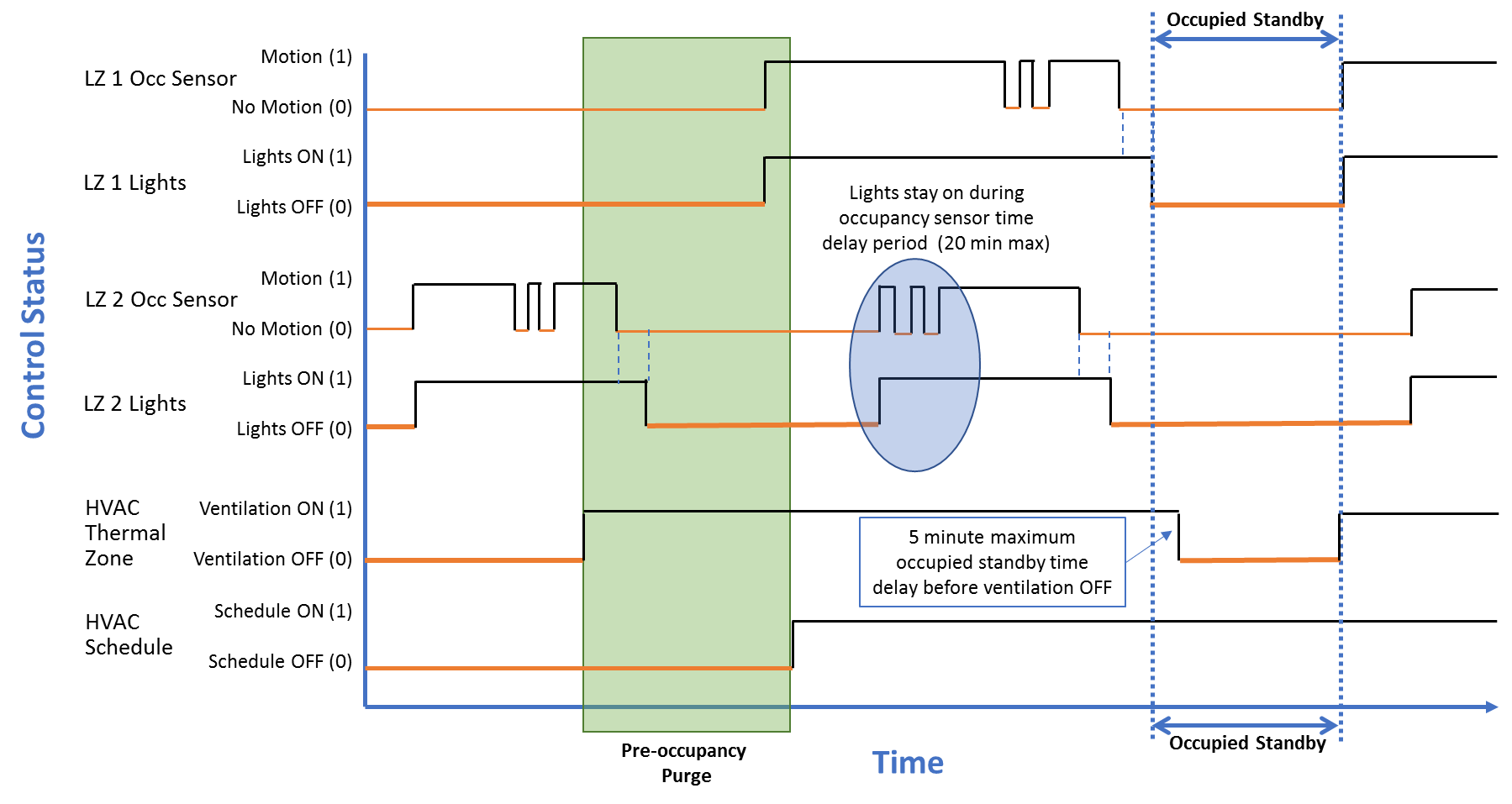
Source: California Energy Commission
Special Note for Dedicated Outdoor Air Systems (DOAS)
HVAC zones utilizing DOAS units must still adhere to occupied standby control requirements.